
The Manchac Swamp Bridge: 22 Miles Over a Ghost Forest
You have probably crossed it. Most people have.
If you have ever driven Interstate 55 north out of New Orleans toward Jackson, you spent a good ten minutes up on a narrow concrete bridge with swamp on both sides, cypress trees standing in black water as far as you could see, and you almost certainly never learned its name. That is the Manchac Swamp Bridge. And the thing under it is a lot stranger than the drive lets on.
I guide kayak trips out here, so I watch it from below all the time. From the water it reads completely differently. Up top it is just a commute. From a boat it is a 22-mile concrete line drawn across a drowned forest, casting a cold shadow over water that swallowed two whole towns. This is the guide to the bridge everyone drives over and nobody actually sees.
The bridge you have driven and never seen
The Manchac Swamp Bridge is a twin concrete trestle carrying Interstate 55, along with US Route 51, across the Manchac swamp in southeast Louisiana, up near the town of Manchac and just south of Ponchatoula. Twin trestle means two separate parallel spans, one for each direction of traffic, running side by side the entire way.
It sits in the low, wet basin between Lake Maurepas to the west and Lake Pontchartrain to the east. That basin is not solid ground. It is not really water either. It is the in-between: soft marsh, open ponds, cypress flats, and channels, the kind of terrain you cannot build a normal highway across because there is no bottom to build on. So they did not build a road. They built a bridge and kept it up in the air for miles.
Quick thing worth clearing up while we are here, because people mix it up constantly. Pass Manchac, the channel this swamp is named for, is not the same as Bayou Manchac up by Baton Rouge. Pass Manchac and Bayou Manchac are two different places, and the bridge crosses the swamp around the pass, not the bayou.
How long is the Manchac Swamp Bridge, really
Here is the number that gets people: 22.8 miles. That is 36.69 kilometers of continuous bridge over swamp.
It opened in 1979. It is the longest bridge on the entire U.S. Interstate Highway System, and it is often called one of the longest bridges over water in the world. You will see it listed a few different ways depending on how a given ranking counts “over water,” but the headline holds. There is nothing else quite like it on the Interstate map.
To picture 22.8 miles: if you set one end at the edge of downtown New Orleans, the far end would land well past the suburbs. You could not walk it in a morning. You would not want to. And the whole span is up on stilts.
Why they built a 22-mile bridge instead of a road
This is where the engineering starts to feel a little insane, in a good way.
The Manchac swamp has no firm ground to build a roadbed on. The muck goes down a long way. So the pilings that hold the bridge up were driven roughly 250 feet down into the soft swamp to reach something solid enough to carry the load. Two hundred and fifty feet is deeper than most buildings you have ever stood in are tall, and it is all buried under water and mud where you cannot see any of it.
None of that came cheap. Building it ran roughly 7 million dollars per mile, which for a 22.8-mile bridge in the 1970s was an enormous public works bill. A few things made it worth doing anyway:
- The swamp basin simply could not support a conventional filled highway
- I-55 needed a continuous, reliable route north from the New Orleans area toward the interstate grid
- A raised trestle rides over flooding and storm surge instead of washing out under it
- Keeping the highway up in the air left the swamp’s water flow underneath mostly intact
- Repairs on a bridge span are more contained than constantly rebuilding a sinking roadbed
So the length is not showing off. It is the swamp dictating terms. The only way across was over.
What is under the bridge (this is the part nobody tells you)
Now the part the drive completely hides from you.
The Manchac swamp is not empty scenery. It is a graveyard with a real history, and the bridge crosses right over the heart of it. This is the same drowned-towns country tied to the great hurricane of 1915, the storm that came up out of the Gulf and put the lake straight through the little railroad settlements strung along the shore.
Two of those towns, Ruddock and Frenier, were wiped off the map and never rebuilt. Their people are part of why this swamp carries the reputation it does. If you want that story in full, we wrote up the towns of Ruddock and Frenier separately, and it is worth your time.
The swamp also carries a genuine haunted reputation, anchored by the legend of Julia Brown, a Frenier woman whose funeral fell on the very day the 1915 storm destroyed the town. The ghost-tour version piles a lot of invented voodoo on top of a real tragedy, and we untangle what is true from what is theater in the Julia Brown legend and the haunted reputation. The short version: the coincidence is real and it needs no help being eerie.
For the whole arc, the logging, the railroad, the storm, the ecology, all of it in one place, start with the full history of the swamp itself. The bridge is just the modern chapter laid on top of a much older story.
You cannot stop on it, so most people never do
Here is the catch that keeps this swamp a secret in plain sight. You cannot stop on the Manchac Swamp Bridge. There is no shoulder to pull off on, no parking, no scenic overlook, no legal or safe way to get out and look. It is an active Interstate at highway speed, and stopping on it is both dangerous and prohibited.
So think about what that means. Millions of people cross this swamp every year, doing 70, and not one of them gets to actually be in it from the bridge. You glance sideways at the cypress, the bridge ends, and the swamp is gone behind you. The one landmark that puts you physically over the swamp is the one place you are not allowed to experience it from.
The swamp underneath is only reachable by boat. From the water. Which is exactly where we come in.
The ghost forest the bridge crosses
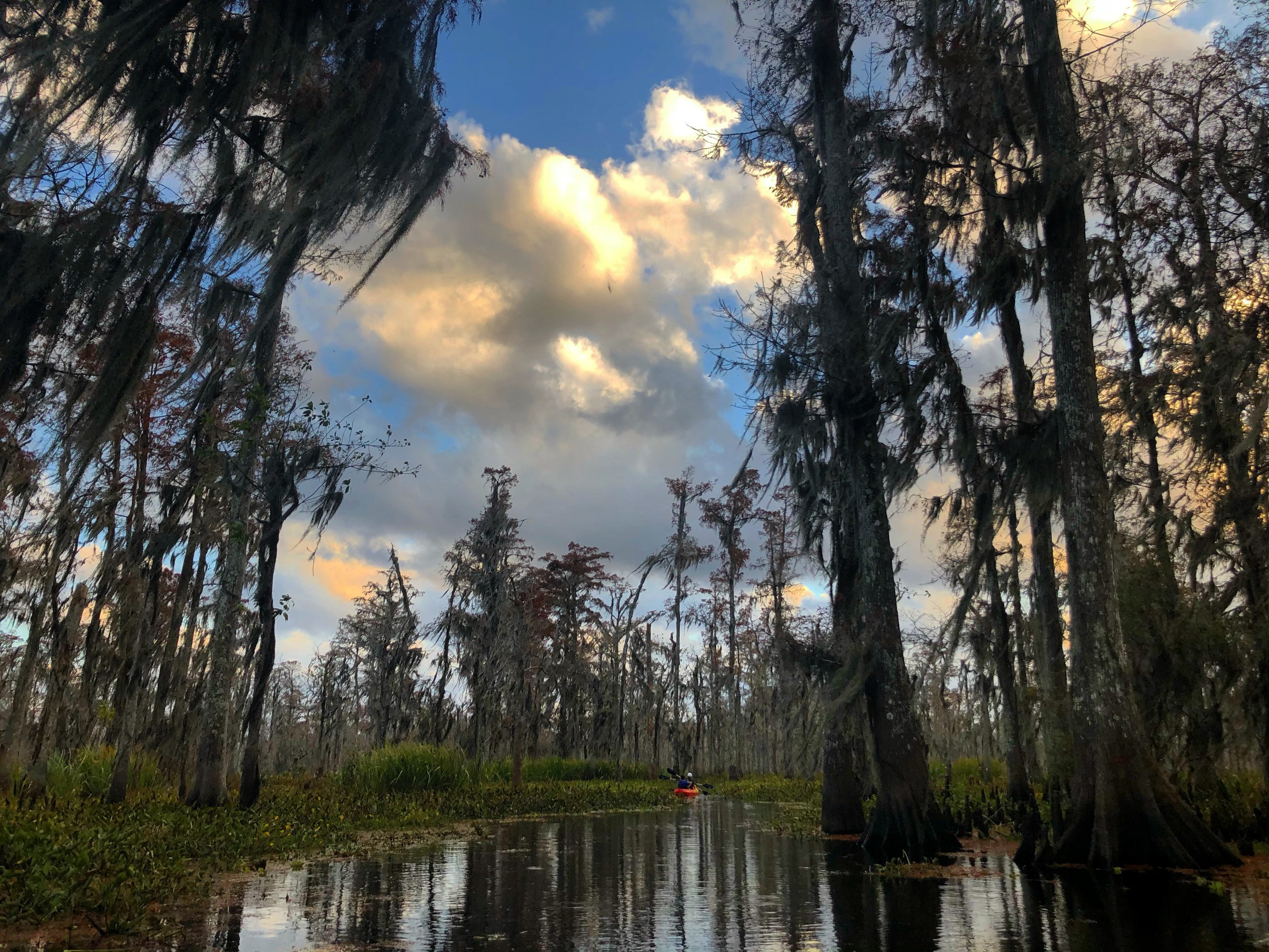
Look out the window on the drive and you will notice a lot of the cypress look dead. Bare gray trunks standing in open water, no canopy, like a forest of bones. People call it the ghost forest, and it is not a Halloween gimmick.
Two things stacked up to make it. Loggers clear-cut most of the old-growth bald cypress here in the late 1800s and early 1900s, hauling the rot-resistant wood out by rail. Then the water changed: saltwater began pushing up from the Gulf and the land itself started sinking, so young cypress could not get a foothold and the forest never grew back the way it fell. What is left is a living swamp full of wildlife, wearing the skeleton of the forest that used to be.
From up on the bridge it is a gray blur at 70 miles an hour. From a kayak it is something else entirely. You drift up next to one of those trunks, close enough to touch it, and you can read a hundred years of the swamp’s history in a single dead tree.
What it feels like to paddle under it
I want to tell you what the bridge is actually like from below, because it is one of the strangest, best moments on our trip.
You are low. Ten feet off the water, no motor, the swamp doing its swamp things around you, herons lifting off, a gator sliding under, the drip of a paddle. And then the shadow of the trestle comes over you and everything shifts. The concrete is massive up close, stained and pitted, marching off in a straight line to a vanishing point in both directions. Way up above, you can hear the muffled thrum of a truck crossing, someone up there running late, no idea you are down here.
That contrast is the whole thing. Up top, 22.8 miles of hurry. Down below, dead silence and black water and a forest that has been standing there, drowned and beautiful, the entire time. You feel very small and very lucky at the same time. That is a feeling you cannot get from a car window, and you cannot get it from an airboat blasting through at volume either. You get it because you are quiet enough for the swamp to forget you are there.
See the swamp the right way
So here is the honest pitch. You have crossed the Manchac Swamp Bridge, or you will. It is a genuinely remarkable piece of engineering and it deserves to be known. But the bridge is a way over the swamp, built specifically so you never have to touch it. To actually experience the place it crosses, you have to get down on the water.
Our Manchac Swamp kayak tour is a two-hour guided paddle, small group, 65 dollars a person, no motors, with a naturalist guide who knows the history you just read and the wildlife you are about to meet. We pick up at 740 N Rampart Street in New Orleans and run you out to the water. Book a morning trip if you want the fog still hanging in the trees. That is when the ghost forest earns its name, and when the bridge overhead feels the furthest away.
See the swamp the right way. From underneath.
Frequently Asked Questions
How long is the Manchac Swamp Bridge?
The Manchac Swamp Bridge is 22.8 miles long, or about 36.69 kilometers. It carries Interstate 55 on twin concrete trestles across the Manchac swamp in southeast Louisiana. It opened in 1979 and is the longest bridge on the entire U.S. Interstate Highway System, often ranked among the longest bridges over water in the world.
Why is the Manchac Swamp Bridge famous?
It is famous for its sheer length and the strange country it crosses. At 22.8 miles it is the longest bridge on the U.S. Interstate system. Its pilings were driven roughly 250 feet into soft swamp, and it cost about 7 million dollars per mile to build. It also crosses the drowned-towns swamp tied to the 1915 hurricane and the Julia Brown legend.
Can you stop on the Manchac Swamp Bridge?
No. There is no shoulder, no parking, and no scenic pull-off on the Manchac Swamp Bridge. It is an active Interstate carrying traffic at highway speed, so stopping is unsafe and prohibited. The swamp below the bridge cannot be reached from the road at all. The only way to actually get into it is by boat or kayak from the water.
What is the best way to see the Manchac swamp?
From the water, in a kayak. The bridge crosses the swamp but is built so you never touch it, and airboats blast through too loud and fast to notice much. A quiet, guided paddle puts you ten feet off the black water among the ghost cypress and wildlife. Our Manchac Swamp kayak tour is a two-hour small-group trip with a naturalist guide.
—