
The Honey Island Swamp Monster: Louisiana’s Bigfoot
Every swamp worth its salt has a monster. Honey Island’s is the real headliner, the one that made it onto national TV, the closest thing Louisiana has to Bigfoot. And here’s the honest part I’ll tell you up front, before you paddle a single stroke: nobody has ever proven it exists. That doesn’t make the story worthless. If anything it makes it better, because the legend grew out of a place so genuinely wild that people needed a creature to explain how untamed it felt.
I run guided trips through this swamp, so I’ve told this story from the bow of a kayak more times than I can count. Let me tell it the way it deserves to be told. Straight, with the local color left in, and clear about which parts are fact and which parts are folklore.
The most famous monster in Louisiana lives in a real swamp
The Honey Island Swamp Monster is said to haunt the Honey Island Swamp, a big stretch of bottomland forest along the Pearl River near Slidell, out on the Louisiana and Mississippi line east of New Orleans. That location matters. This isn’t a made-up swamp in a made-up county. It’s a specific, mappable, drivable-to place, which is a lot of why the legend has legs.
Ask around Slidell and you’ll get told, with a straight face, that something lives back in there. Most people have never seen it. Everybody knows somebody who knows somebody who did. That’s how these things work, and that’s exactly the shape of a good swamp legend.
What the legend says it looks like
I want to be careful here, so read every one of these details as reported, not confirmed. According to the accounts that built the legend, the creature is:
- Roughly 7 feet tall, standing upright
- Covered in coarse gray hair
- Marked by amber or yellow eyes that supposedly catch the light
- Trailed by a terrible smell, the kind people describe as rotting and swampy
- Sometimes said to leave webbed or three-toed tracks in the mud
Put those together and you get something between an ape and a reptile, which is a little different from the usual Bigfoot template. The three toes and the webbing are the details that make Honey Island’s monster its own thing. As the story goes, that’s what set the tracks apart from any bear or gator or wild boar somebody might have confused for a beast in bad light.
None of this has ever been verified. It’s a description assembled from decades of reports, and I tell my guests that plainly. It’s folklore, and folklore has its own kind of truth without needing to be literally true.
The Cajun name: Letiche and the Tainted Keitre
Long before it hit television, local Cajun folklore had names for the thing. It gets called the “Letiche” and, in some tellings, the “Tainted Keitre.” The old stories tie the Letiche to a lost or abandoned child raised wild by alligators in the swamp, which is a much stranger and older idea than a hairy hominid, and honestly a little haunting when you’re sitting in still water at first light.
I love that layer of it. The monster wasn’t invented by a TV crew. There was already a name waiting in the language of the people who lived closest to this swamp, which tells you the swamp had been growing legends for a long, long time.
Harlan Ford, the 1963 sighting, and the plaster casts
The modern legend, the version most people know, traces back to one man: Harlan Ford, a retired air traffic controller who spent his free time deep in the Honey Island Swamp. As the story goes, Ford encountered the creature in 1963 while out in the swamp, and the sighting stuck with him for the rest of his life.
The part that gave the story real staying power came later. In 1974, Ford said he found a set of strange tracks in the swamp and brought out plaster casts of them. Odd tracks, not matching anything people expected. Those casts became the physical centerpiece of the whole legend, the closest thing to evidence anybody ever produced. The story went on to feature on the classic TV show In Search Of, which is how a local Slidell tale became a national one.
Here’s where I stay honest with my guests. Casts of tracks are not proof of a creature. They’re proof that somebody found some tracks and made casts. What made them is exactly the open question the legend has never closed. Ford believed what he saw. I’m not going to call a dead man a liar. I’m also not going to tell you a 7-foot ape-reptile is out there behind the next cypress. Both things can be true: he was sincere, and it was never verified.
Why a story like this sticks to this particular swamp
Now the part I actually care about, because this is where legend and real place meet.
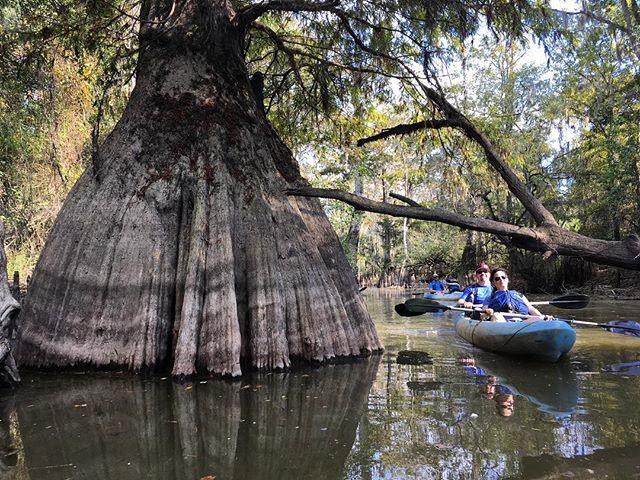
Honey Island Swamp is, no exaggeration, one of the least-altered river swamps in the United States. This is a genuinely wild bald-cypress and tupelo river swamp on the Pearl River, not a drained and re-flooded remnant, not a park with a boardwalk and a snack bar. It’s dense, it’s quiet in a way that gets under your skin, and it’s big enough that you can lose your sense of direction fast if you don’t know it.
Wildness like that does something to the human imagination. When you’re back in there and the light goes green under the canopy and something big moves in the brush that you can’t see, your brain reaches for an explanation. A hundred years ago that explanation had a name in Cajun French. Fifty years ago a man made plaster casts. The monster is, when you really think about it, the swamp’s own way of telling you how untamed it still is. The legend is a symptom of the realness of the place.
That’s not a knock on the story. That’s the highest compliment you can pay a swamp.
What actually lives out here (and it’s plenty)
You don’t need a cryptid to have your pulse jump on this water. The Honey Island Swamp is stacked with real animals, and some of them are plenty big enough to get your attention. On a normal paddle, depending on season and luck, you’re looking at:
- American alligators, the genuine apex reptile, sunning or cruising low
- Wading birds working the shallows: great blue herons, egrets, ibis
- Wild boar back in the brush, which absolutely crash around and spook people
- Snakes, including the ones you want to identify from a respectful distance
- Turtles stacked on every fallen log
- Owls, woodpeckers, and the constant birdsong of a healthy bottomland forest
I go deeper on all of it in the piece on the wildlife you actually see out here. The short version: a wild boar moving through palmetto at dusk, unseen, is a very convincing monster. So is a big gator sliding off a bank you didn’t know was occupied. The swamp gives your imagination a lot to work with, and it doesn’t need to invent a thing to do it.
What guests ask me about the monster at dawn
I run a lot of morning trips, launching when the fog is still sitting on the water, and the monster question comes up on nearly every one. It’s usually the third or fourth thing out of somebody’s mouth once we’re off the launch and the city noise is gone.
The four I hear the most:
- Have you ever seen it? (No. I’ll tell you straight, no.)
- Do you actually believe in it? (I believe people saw something. That’s a different sentence.)
- Is it dangerous, should we be worried out here? (Not from the monster. Respect the gators and the boars and you’re fine.)
- Where did the whole thing start? (Which is the Harlan Ford story you just read.)
What I’ve noticed after all these trips is that people don’t really want me to confirm the monster is real. They want the story told well, and they want to feel, for two seconds at dawn in the fog, that it could be. The swamp delivers that feeling for free. My job is just to not ruin it with a shrug.
The real payoff: paddling the country the legend comes from
So here’s where I land it. The Honey Island Swamp Monster is folklore, and I’m not going to pretend otherwise to sell you a ticket. But the swamp is not folklore. The swamp is real, and it’s one of the wildest, most intact river swamps left in the whole country, and you can get in a kayak and paddle right through the middle of the country the legend comes from.
That’s the trip. Silent boats, no motors, small group, a naturalist guide who knows the difference between the story and the science and will give you both. You slip in low and quiet, the way you have to if you want the swamp to forget you’re there. You’ll see gators. You’ll hear things you can’t place. And somewhere back in the tupelo, if the fog cooperates, you’ll understand exactly why people needed a monster to explain this place.
If you’re weighing your options, I broke down how Honey Island stacks up against Manchac, the other great swamp near New Orleans, which has its own ghost story and a drowned-town history worth its own trip.
But if it’s the monster’s home water you want, come paddle it. Our Honey Island Swamp kayak tour is a small-group, naturalist-led paddle at $65 a person, no motors and no baiting, through the real swamp behind the legend. Book a morning slot if you want the fog. That’s when the story feels closest to true.
Frequently Asked Questions
Is the Honey Island Swamp Monster real?
No creature has ever been verified. The Honey Island Swamp Monster is folklore, Louisiana’s most famous cryptid legend, built from decades of reported sightings and the plaster casts of tracks Harlan Ford brought out in 1974. What is completely real is the swamp itself, one of the least-altered river swamps in the country, wild enough that the legend has stuck for generations.
What is the Honey Island Swamp Monster?
It’s a creature said to haunt the Honey Island Swamp along the Pearl River near Slidell, Louisiana. According to the legend it stands about 7 feet tall, is covered in gray hair, has amber eyes and a terrible smell, and leaves webbed or three-toed tracks. Cajun folklore calls it the Letiche or Tainted Keitre. Every one of those details is reported, not proven.
Can you visit the Honey Island Swamp?
Yes, and a kayak is the right way to see it. It’s a genuinely wild bald-cypress and tupelo river swamp on the Pearl River east of New Orleans. Our guided Honey Island Swamp kayak tour is a small-group, naturalist-led paddle at $65 a person, no motors, no baiting, through the same wild country the legend comes from. You’ll see gators, birds, and dense swamp forest.
Where is the Honey Island Swamp Monster supposed to live?
The legend places it in the Honey Island Swamp, a large stretch of river-bottom forest along the Pearl River near Slidell, on the Louisiana and Mississippi line east of New Orleans. The modern story traces to Harlan Ford, who said he encountered the creature there in 1963 and later found strange tracks in the swamp that he cast in plaster in 1974.