
Alligator vs Crocodile: What’s the Difference?
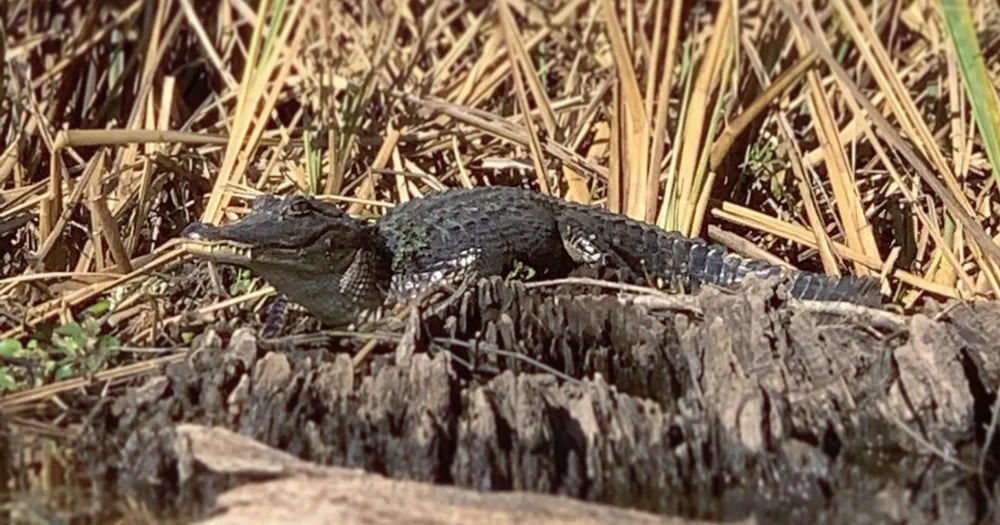
People ask me this one on the water almost every trip. Someone points at a gator sunning on a log and says, wait, is that an alligator or a crocodile? Fair question. The two animals get mixed up constantly, they show up in the same cartoons, and half the internet uses the words like they mean the same thing.
They don’t. Here’s the clean version, the one you can actually remember, followed by the part that matters if you’re coming to a New Orleans swamp: out here it’s always an alligator. No, that’s not a crocodile. We’ll get to why.
Same family reunion, different branch
Start with what they share. Alligators and crocodiles are both crocodilians, an ancient order of reptiles that also includes caimans and the skinny-snouted gharials. Same broad family reunion. They’ve been around, more or less in this shape, since the dinosaurs were still paying rent.
But they sit on different branches. Alligators belong to one family, crocodiles to another, and once you know what to look for you can tell them apart in about two seconds without getting close. Which is the right distance anyway.
The snout is the fastest tell
If you remember one thing, remember the nose.
An alligator has a wide, U-shaped snout, broad and rounded at the front, kind of like a shovel. A crocodile has a narrower, V-shaped snout that tapers to a point. That difference isn’t cosmetic. The gator’s broad jaw is built for crushing hard prey like turtles. The croc’s pointier snout is a more general-purpose tool.
U for alligator. V for crocodile. That’s the whole cheat code.
Alligator vs crocodile, side by side
Here’s the fast-scan version. Tape it to your brain.
| Feature | Alligator | Crocodile |
|---|---|---|
| Snout shape | Wide, U-shaped, rounded | Narrow, V-shaped, pointed |
| Teeth when mouth is closed | Only the upper teeth show, lower ones tuck out of sight | Teeth interlock and stick out top and bottom, including a big 4th lower tooth |
| Color | Dark, blackish-gray | Lighter, olive to tan |
| Preferred water | Freshwater: swamps, bayous, marshes | Tolerates brackish and saltwater (has salt glands) |
| US range | Across the Southeast: Louisiana, Florida, Texas and more | Only the far southern tip of Florida |
| Temperament | Generally shyer, more skittish | Generally more aggressive |
The teeth, and the famous toothy grin
The mouth gives it away too, if the animal is close enough to see (from a kayak, it sometimes is).
An alligator’s upper jaw is wider than its lower jaw. So when a gator closes its mouth, the upper teeth hang over and hide the bottom ones. You mostly see a smooth top row and a closed line. A crocodile’s jaws are about the same width top and bottom, so the teeth interlock and jut out both directions when the mouth is shut. That includes a big fourth tooth on the lower jaw that pokes up outside the snout and gives crocs their trademark toothy grin.
Smooth-lipped and tidy, you’re looking at a gator. Snaggle-toothed grin, that’s a croc. Simple as that.
Color and water: dark freshwater vs lighter saltwater
Two more tells that travel together.
Color. Alligators run dark, a blackish-gray that reads almost black in tea-colored swamp water. Crocodiles tend to be lighter, an olive to tan that fits the sandier, brighter coastal spots they favor.
Water. This one’s a real biological difference, not just a preference. Crocodiles have functioning salt glands in their tongues that let them shed excess salt, so they handle brackish and saltwater fine, mangroves, estuaries, coastlines. Alligators have those glands too but they don’t really work, so gators stick to freshwater: swamps, bayous, marshes, slow rivers. When you’re paddling black freshwater a half hour outside New Orleans, that alone tells you which animal you’re looking at.
Where each one actually lives
Range is where this stops being trivia and starts being useful.
The American alligator lives all across the U.S. Southeast, Louisiana, Florida, Texas, the Carolinas, plenty of Georgia and Alabama. There’s also a separate, smaller alligator species over in China, but in North America the gator is the Southeast’s animal. Millions of them.
The American crocodile in the United States is a totally different story. Its U.S. range is tiny: only the very southern tip of Florida, down around the Everglades, Florida Bay, and the Keys. That’s it. So the only place in the entire country where wild alligators and wild crocodiles overlap is that little corner of south Florida. Everywhere else in the Southeast, if you see a big reptile in the water, it’s a gator.
Temperament: shy vs pushy
Here’s the part people get backwards because of movies. American alligators are generally the shyer, more skittish of the two. Most of the time a wild gator wants nothing to do with you and will slip off a log into the water the second it clocks a person. Crocodiles, especially some of the Old World species, are far more aggressive by reputation.
I’ll add the guide caveat, because it matters. Shy does not mean tame. A wild alligator is still a large predator and deserves distance and respect, which is exactly why we don’t bait them and never crowd them. If you’re wondering how that plays out in a boat, we wrote up how safe kayaking near them really is and, the question everyone secretly has, whether gators go after kayaks.
Louisiana is alligator country, full stop
So let’s land the plane. In Louisiana there are only alligators. No wild crocodiles. None. The state’s wild alligator population runs well into the millions, and the swamps and bayous around New Orleans, Manchac and Honey Island included, are prime American alligator habitat. Freshwater, dark water, exactly what they like.
That’s why, when a guest points and asks, the answer on our trips is always the same. No, that’s not a crocodile. You’d have to drive to the bottom of Florida to have that conversation. If you’re curious whether New Orleans has wild gators in the first place, and when they’re most active through the year, we’ve got both mapped out.
What that means on the water with us
Knowing a gator from a croc is fun trivia until you’re ten feet from one, quiet, no motor, watching it decide you’re not worth the trouble. That’s the payoff.
We run the Manchac Swamp kayak tour as a small-group, two-hour guided paddle, $65 a person, launching from our pickup at 740 N Rampart Street in New Orleans. No motors. No baiting, ever. Just a naturalist guide, silent kayaks, and a swamp full of American alligators doing their thing on their own terms. I won’t promise you’ll see one on any given morning, nobody honest can promise wildlife, but this is their water, and the quiet way in is the way you actually get close. See the swamp the right way.
Frequently Asked Questions
How can you tell an alligator from a crocodile?
Look at the snout first. An alligator has a wide, U-shaped, rounded snout, while a crocodile has a narrow, V-shaped, pointed one. Next the teeth: on a gator with its mouth closed only the upper teeth show, but a croc’s teeth interlock and stick out top and bottom, including a big fourth lower tooth. Alligators are also darker and prefer freshwater, crocodiles are lighter and tolerate saltwater.
Are there crocodiles in Louisiana?
No. Louisiana has only American alligators in the wild, no crocodiles at all. American crocodiles in the United States live only at the far southern tip of Florida, around the Everglades and the Keys. So every large reptile you spot in a Louisiana swamp, bayou, or marsh is an alligator. The state’s wild gator population runs into the millions, which is why the swamps around New Orleans are such reliable gator country.
Are there alligators or crocodiles in New Orleans?
Alligators. The freshwater swamps and bayous around New Orleans, including Manchac where we paddle, are American alligator habitat, and there are no wild crocodiles anywhere in the region. Crocodiles and alligators only share territory in one small part of the country, the southern tip of Florida. So on a New Orleans swamp tour, if a guide or another guest calls it a crocodile, it’s an alligator.
—