
Alligator Season in Louisiana: Mating, Nesting, and When Baby Gators Appear
People ask me all the time when they can come see a gator. Fair question. The honest answer is that alligators run on a calendar, and it’s a temperature calendar, not a month-on-the-wall one. Once you understand how the year moves for them, you can pretty much predict what the swamp will be doing before you launch.
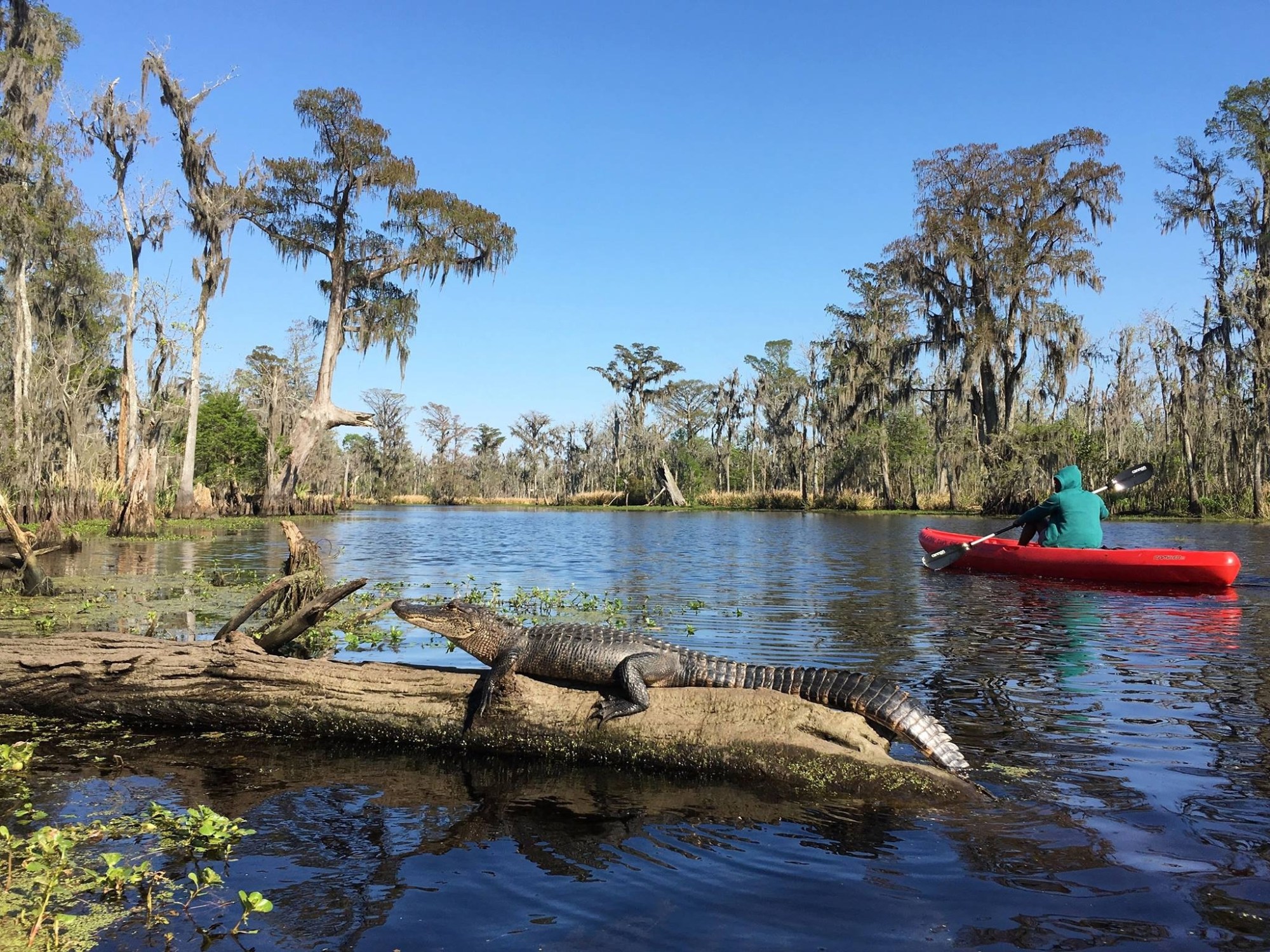
I’ve paddled Manchac in every season there is. Some mornings the water is dead still and empty. Other mornings there’s a six-foot gator sunning on a log ten feet off the bow, not caring one bit that you’re there. The difference is almost always the thermometer. So let’s walk the year the way an alligator lives it.
The short version, for people who just want the calendar
Here’s the whole cycle in one glance, and then I’ll break each piece down.
- Winter: cold-blooded and dormant. You rarely see them.
- April and May: they wake up, warm up, and the males start bellowing.
- May into June: mating season.
- June and July: females build nest mounds and lay eggs.
- Late August into September: the eggs hatch and the babies appear.
- Late spring through early fall: the best stretch for paddlers to actually see one.
That’s it. The rest is detail, and the detail is where it gets good.
Winter: the swamp goes quiet (brumation)
Alligators are cold-blooded. They don’t generate their own heat, they borrow it from the sun and the water, so when the swamp cools off, they downshift hard. Below about 70 degrees they go largely inactive, sliding into a winter dormancy called brumation. Think of it as a reptile’s version of hibernation, except they don’t fully sleep. They just stop moving much, stop feeding, and hunker down in dens and mud banks and the bottoms of bayous, sometimes with just their snouts poking up.
This is why a cold-season paddle usually means no gators. People book a January trip expecting the postcard and get quiet gray water instead. The swamp is beautiful in winter, honestly, all bare cypress and fog, but the alligators are essentially offline. Don’t take it personally. They’ll be back when it warms.
Spring: the bellowing starts
Then April comes, the water climbs back past 70, and the whole swamp seems to remember itself.
This is my favorite window to be out there. Courtship ramps up through April and May, and the males start bellowing. If you’ve never heard it, a bellow is a deep, rolling rumble that carries across open water, and up close you can sometimes feel it in your chest more than hear it. I’ve had a bull gator let one go a hundred yards off on a still spring morning, and every guest in the group went dead silent at the same time. It does something to you. Some of the older, bigger males will even do the “water dance,” where the low-frequency rumble makes the water above their backs jump and spray. Spring is when the swamp turns the volume back up.
Two things are happening at once here. The gators are active again, hungry after a long dormant winter, and they’re in full display mode. Great time to be a paddler.
Late spring into summer: mating season
Mating happens roughly May into June. The bellowing and courtship of spring pays off, the males and females pair up, and things get busy across the swamp.
Alligators are more active and more visible during this stretch, which is a gift and a reason to keep your distance both. A big male on the move during mating season is not looking for trouble with a kayak, but he’s got other priorities and a lot of energy, so you give him room and let him do his thing. That’s just good manners in their house. If you’re wondering whether it’s still safe to share the water with them during the busy months, the short version is yes, with respect and space, and we get into the full picture of whether it’s safe to kayak with alligators in its own guide. People also ask me flat out whether a gator would ever go after a kayak, and that one deserves a real answer too.
Summer nesting: give the mounds a wide berth
After mating, the females get to work. In June and July she builds a nest, and it’s a serious piece of engineering. She piles up a mound of vegetation, mud, and rotting plant matter, usually along a shoreline or a hummock, and lays her clutch of eggs inside it. A typical clutch runs somewhere around 20 to 50 eggs. The decaying plants generate heat as they break down, and that heat is what incubates the eggs. No sitting on a nest like a bird. She lets the compost do the warming.
Now here’s the part every paddler needs to hear. A nesting female guards that mound fiercely. She’ll stay close, and she will not tolerate something wandering up on it. This is the one time of year I tell people to be genuinely careful. If you spot a big mound of piled vegetation along the bank in summer, you give it a wide berth, full stop. Don’t drift in for a closer look, don’t try for the photo. That’s a protective mother, and she’s earned her space. Knowing what to do if one gets close matters most in exactly this season.
The good news for viewing: summer is peak activity. The gators are out, the water is warm, and as long as you keep a respectful line, it’s one of the best stretches of the whole year to see them.
Late summer into fall: the hatch
Incubation runs roughly 60 to 70 days. So those June and July eggs start hatching in late August into September, and this is the sweet, strange payoff of the whole cycle.
There’s a detail here that gets people every time. The temperature inside the nest determines the sex of the hatchlings. Warmer nests produce males, cooler nests produce females, and nests that sit in between produce a mix. So the exact spot the mother chose, and the weather that summer, quietly decides who her babies turn out to be. Nature does not do this the way we’d expect, and I never get tired of watching that land on people’s faces.
The hatchlings come out tiny, about 6 to 8 inches, striped, and loud. They make little grunting yelps, and when they call, mom comes. She stays protective for a good while after they hatch, and you’ll sometimes see a cluster of babies rafted up near her at the surface or riding the shallows close to the bank. A mom-and-babies sighting in early September is one of the best things this swamp offers. It’s also, again, a keep-your-distance moment. A mother with a fresh clutch of hatchlings is exactly as protective as she sounds.
So when should you actually paddle out to see one?
Here’s the question underneath all the biology, and the answer is simple.
The warm months. Roughly late spring through early fall is your window, and if I had to circle the peak, it’s late spring and summer, when the gators are most active and most visible. A warm, sunny morning after a stretch of warm days is close to ideal, because they’ll be up on the banks and logs pulling in heat.
A few honest caveats from someone who’s out there all the time:
- Cold snaps shut it down fast. Even in the shoulder seasons, a cold front can send them back into hiding for days. Warm and stable beats warm-then-cold every time.
- Morning is my pick. Early light, calm water, and gators warming up after the cool night. It’s also when the whole swamp is at its best.
- I never guarantee a sighting. Nobody honest does. These are wild animals on their own schedule, not a zoo exhibit. Most warm-season mornings we see gators. Some we don’t, and that’s the deal with real wildlife.
- The population is on your side. Louisiana holds a huge wild alligator population, well over a million animals statewide, so when conditions are right, the odds are genuinely good.
If you want the bigger-picture timing beyond just gators, weather, water, bugs, all of it, I laid out the best months to paddle the swamp overall in a separate post. And if you’re coming from the city and wondering where you can actually find them near the city, that’s covered too.
How we do it, and how we don’t
One last thing, because it’s the whole reason this outfit exists. You’ll see other operators out here running airboats and tossing marshmallows or bait to make a gator perform on cue. It works as a show. It also teaches wild alligators to associate people and boats with food, which is bad for them and bad for the next paddler who comes through.
We don’t do that. Our Manchac Swamp kayak tour is a two-hour guided paddle, small group, $65 a person, no motors and no baiting, with pickup at 740 N Rampart Street in New Orleans. You sit low, quiet, and close to the water, and you see the swamp on its own terms. In gator season, that means you might drift up on one that has no idea you’re there, because there’s no engine announcing you and no bait bribing it. That’s the version worth seeing. See the swamp the right way.
Frequently Asked Questions
When is alligator mating season in Louisiana?
Courtship starts as the swamp warms in spring, with males bellowing through April and May, and actual mating happens roughly May into June. It’s all driven by temperature. Once the water climbs back past about 70 degrees, the alligators come out of their winter dormancy and get active, and the bellowing and pairing follow from there. Late spring is when the swamp really turns loud.
When do baby alligators hatch?
Females build nest mounds and lay their eggs in June and July, and incubation runs roughly 60 to 70 days. That puts hatching in late August into September. The babies come out about 6 to 8 inches long, striped, and noisy, and they stay close to their mother, who guards them fiercely for a good while. An early-September sighting of a mom with her hatchlings is one of the best things the swamp offers.
What is the best time of year to see alligators?
The warm months, roughly late spring through early fall, with peak activity in late spring and summer. Alligators are cold-blooded, so once temperatures rise they spend more time out sunning on logs and banks where you can actually see them. A warm, stable, sunny morning is close to ideal. Cold snaps send them back into hiding, so warm and steady beats a warm day chased by a cold front.
Why don’t you see alligators in the winter?
Alligators are cold-blooded, and below about 70 degrees they go largely inactive, sliding into a winter dormancy called brumation. They tuck into dens and mud banks, stop feeding, and barely move until things warm back up. That’s why a cold-season paddle usually turns up quiet gray water instead of the gator you were hoping for. The swamp is still beautiful in winter, the alligators are just essentially offline.