
How Close Do You Get to Gators in a Kayak? No Bait Ever
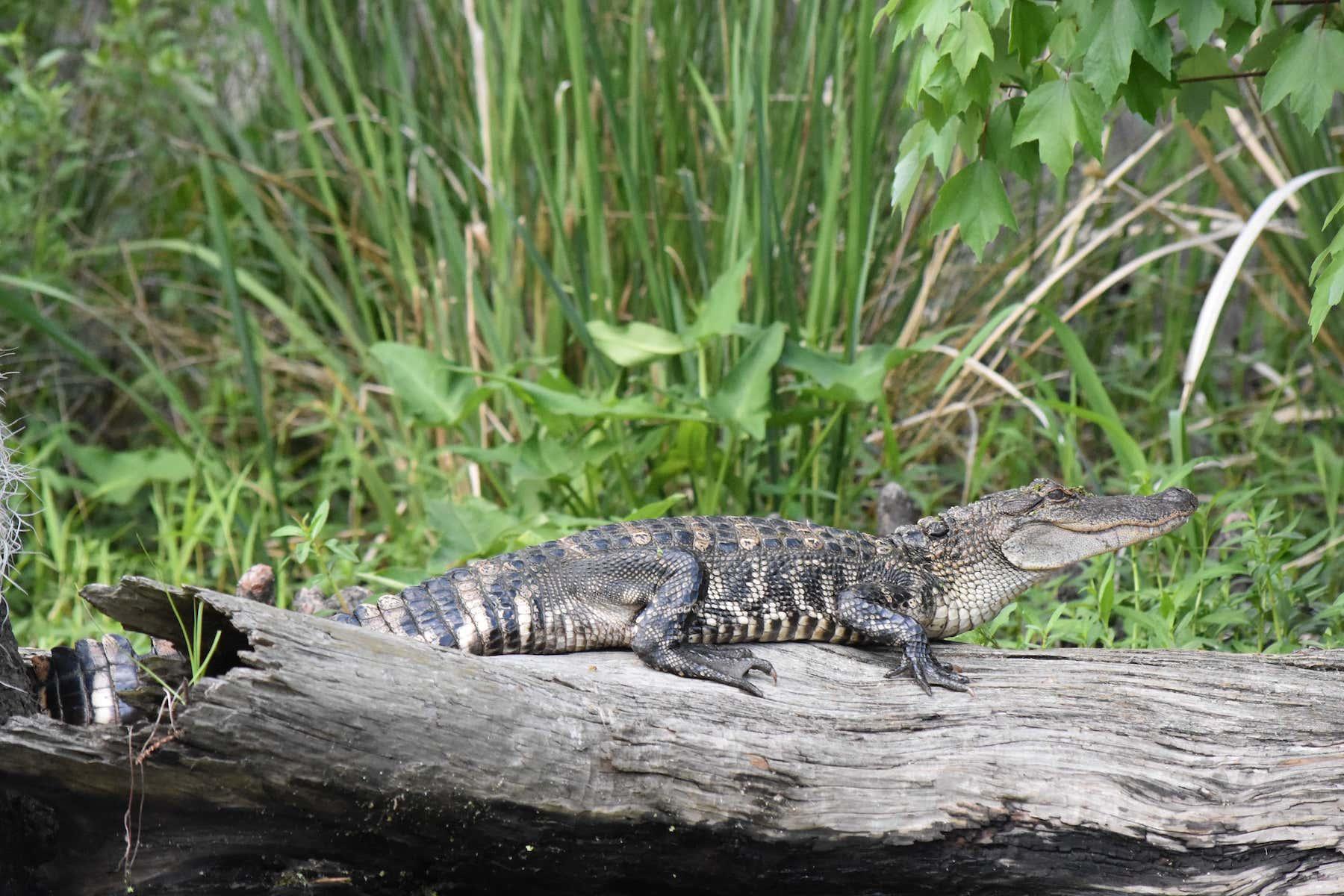
The first time a wild gator surfaces a rod’s length off your bow, you go dead silent. Not because you’re scared. Because you don’t want to break it. That six-footer has no clue you’re there, and the only reason is that you came in on a kayak with no engine, no wake, nothing to warn him. That is the closest most people ever get to a wild alligator. And we did it without throwing him a single marshmallow.
That’s the whole pitch, honestly. People ask me all the time how close you really get to gators out here, and the real answer surprises them: closer than an airboat, most days, precisely because the boat is quiet. Let me walk you through why, and why we flat-out refuse to bait them.
The quiet is the whole trick
An alligator’s whole survival strategy is reading vibration. They feel a motor coming from a long way off, and a big wild one will sink and vanish before an airboat is anywhere near. So the airboat crowd solves a problem they created. They scared the gator off with the engine, so now they have to lure him back with food. Round and round.
We skip both steps. No motor to spook him, no bait to bribe him back.
In a kayak you sit maybe a foot off the water. You paddle slow, you drift, and the swamp forgets you’re in it. On a warm morning out on the Manchac Swamp I’ve had gators surface a few boat-lengths away and just hang there, eye above the waterline, doing gator things. No performance. No feeding. Just an animal in its house who never registered us as a threat. That is a genuinely wild encounter, and it beats a staged one every single time.
What gator baiting actually is
If you’ve never seen it, here’s the move. The guide on a motorboat or airboat pulls up, and to guarantee the boatload of tourists a photo, they toss food in the water: marshmallows, mostly, sometimes raw chicken or hot dogs. The gator, who’s been conditioned by every boat before this one, comes charging up and lunges for it. Everybody gasps. Cameras out. Guaranteed sighting, delivered on schedule.
Marshmallows, by the way. Think about that. A wild apex predator trained to associate the sound of a boat with a bag of Jet-Puffed.
It looks like a nature encounter. It’s closer to a vending machine.
Why lazy operators bait (and why it’s a scam)
I’ll say the quiet part out loud. Operators bait because it’s the easy way to sell a guaranteed product. A wild gator is unpredictable. Some days he’s up, some days he’s buried in the duckweed and you paddle for two hours and see a tail. That unpredictability is hard to sell to someone who booked a “see alligators” tour and wants their money’s worth.
So instead of doing the harder work (knowing the water, reading the season, putting you in the right spot quietly), they cheat. They turn a wild animal into a trained one so the photo is bankable. Here’s the thing though:
- The gator isn’t behaving naturally, so you’re not actually seeing wild behavior
- The animal is now habituated to people, which is a slow death sentence for him
- Every other paddler and boater on that water inherits a gator who now expects food from humans
- And it’s illegal in Louisiana to feed wild alligators, which is worth saying plainly
You paid to see the swamp. You got a circus act with a reptile that’s been Pavloved into performing.
What baiting does to the gator
This is the part that actually gets me. Feeding wild gators doesn’t just cheapen the experience, it wrecks the animal.
A wild alligator that keeps its natural fear of people is a safe alligator. He avoids you, you avoid him, everybody keeps their fingers. The second you start feeding him, that fear erodes. He learns humans equal food. He starts approaching boats, docks, kayakers, swimmers. And a gator that approaches people isn’t “friendly.” He’s now what the state calls a nuisance gator, and nuisance gators get trapped and killed. Not relocated. Killed, most of the time, because a food-conditioned gator can’t be untrained.
So the marshmallow that got a tour group their photo in April can be the reason that same gator is dead by fall. The baiting operators are quite literally loving these animals to death for a tip. I don’t say that to be dramatic. I’ve watched it play out on this water for years.
We don’t participate. Not once, not for a special guest, not for a better photo. If you want the honest side-by-side, we broke down kayak versus airboat in full.
So is it safe to be that close?
Here’s the fear nobody says out loud, so I’ll say it for you: if I’m a few feet from a wild gator in a plastic boat, am I about to become a headline?
No. And I mean that.
Wild alligators do not see a human in a kayak as prey or as a fight worth having. Their instinct is avoidance. Ninety-something percent of the time, a gator’s response to you is to slip under the surface and be somewhere else. The bites you hear about in Louisiana almost always trace back to one thing: a gator that got fed by people and lost its fear. Which, again, is exactly the behavior baiting creates and we refuse to.
A few things keep it genuinely safe on our trips:
- We keep respectful distance and never crowd or corner an animal
- We never feed, splash at, or harass wildlife to get a reaction
- Groups stay small, so we can actually manage the water and talk to each other
- Your guide has done this water for years and reads gator body language for you
- We go low and slow, which keeps everything calm, including the gators
- We match the season, so we’re never forcing an encounter that isn’t there
If you want the deeper version, we wrote a whole piece on whether it’s safe to kayak with alligators. Short version: respect the animal, don’t feed it, keep your distance, and it’s one of the calmest wildlife experiences you’ll ever have.
How we keep it close and respectful
There’s a craft to getting you close without crossing a line, and it’s the opposite of baiting.
It’s water knowledge. It’s knowing that on a cool morning the gators will be up on the banks catching sun, and on a blazing afternoon they’ll be logged in the shade. It’s approaching from downwind and downcurrent, paddle up, no splashing, letting the boat glide the last stretch so the animal never spikes. It’s reading a gator’s posture and knowing when he’s relaxed versus when we’ve gotten close enough and it’s time to ease off and give him room.
That’s the job. Anybody can throw a marshmallow. Putting you fifteen feet from a calm wild gator who’s completely at ease, and keeping it that way, that takes actually knowing the swamp. If you want to know exactly where the gators are around New Orleans, we mapped that out too.
When to come if gators are the goal
Straight talk on timing, because I won’t sell you a winter trip promising a gator parade.
Alligators are cold-blooded, so they run on temperature. Warm months, roughly April into October, are when they’re most active and most visible, basking on logs and cruising the shallows. That’s prime gator season out here. When the water cools down in winter, they drop into brumation, a kind of reptile dormancy, and mostly disappear into the mud and dens. You’ll see far fewer, sometimes none.
I still love a cold, foggy paddle for the quiet and the birds. But if the whole reason you’re booking is gators, come in the warm season and come in the morning. We laid out the best time to paddle if you want the month-by-month.
And I’ll say it once more so it’s clear: we never guarantee a sighting. The swamp isn’t a zoo. What I can promise is that whatever you see, you saw it because the animal chose to be there, not because we tricked it with food.
See the swamp the right way
Close enough to hear a gator exhale. Quiet enough that he never knew you came. No engine, no bait, no marshmallow circus. Just you, a paddle, and a wild place doing what it does when nobody’s revving through it.
Our Manchac Swamp kayak tour is a two-hour guided paddle, small group, $65 a person, with pickup at 740 N Rampart Street in New Orleans. No motors. No baiting. A real naturalist guide who knows the water and reads the gators for you. Book a warm-season morning and come see the swamp the right way.
—
Keep reading: what to do if a gator gets close, and do gators actually attack kayaks.