
Snakes in the Louisiana Swamp: What to Know (and Why Not to Worry)
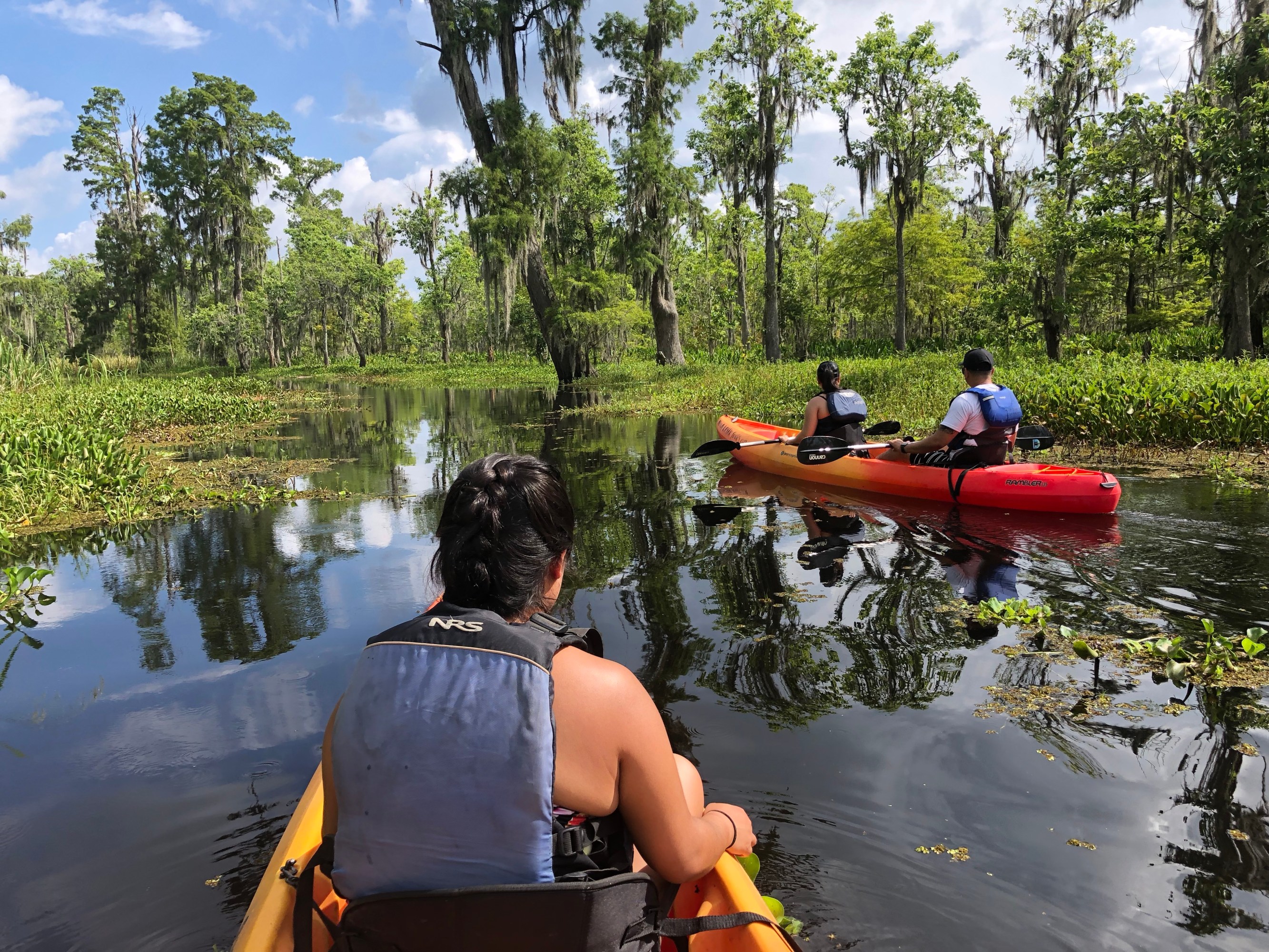
Let me guess why you’re reading this. You want to paddle a Louisiana swamp, the idea sounds incredible, and then some corner of your brain goes: wait, snakes. I hear it on the phone all the time. A guest gets quiet at the put-in, scans the water, and finally asks the real question they came with.
So here’s the honest answer up front, before any of the details. In years of running small groups through this swamp, a snake has never been the problem anybody thought it would be. Most of the ones you’ll see are harmless. The one that isn’t wants nothing to do with you. And from a kayak, a snake sighting lands in the “cool thing I saw” column, not the “scary thing that happened” column. Stick with me and I’ll show you why.
First, the part that calms most people down
Snakes are not out here hunting people. That is not how any of this works.
A snake’s whole survival strategy is avoiding things bigger than it, and you, in a boat, are enormous. Bites are rare, and the ones that do happen almost always come from somebody trying to grab, corner, or kill the animal. Leave a snake alone and the odds of a problem drop to about nothing. That single sentence covers maybe 90 percent of what you need to know, and the rest of this post is just filling in the picture so it stops being a mystery.
The snakes you’ll actually see: harmless water snakes
Here’s the thing nobody tells the nervous first-timer. Louisiana has a lot of snake species, and most of what you’ll spot in the swamp are non-venomous water snakes going about their day.
The common ones are the banded and broad-banded water snakes. Thick-ish body, blotchy or banded pattern, often draped on a low branch over the water or swimming with its head up. And here’s the catch that trips up almost everybody: these harmless water snakes are the snakes people constantly mistake for cottonmouths. Same habitat, similar coloring, similar vibe. A guest points and whispers “moccasin,” and nine times out of ten it’s a water snake that has zero interest in anything but the fish under it.
I had a woman on a morning trip last spring go rigid when she spotted one coiled on a limb about fifteen feet off. Convinced it was a cottonmouth. It was a broad-banded water snake, totally harmless, sunning itself. We drifted, watched it for a minute, and by the end she was the one telling the rest of the group to look. That shift, from fear to fascination, happens more than you’d think once you know what you’re looking at.
Water snakes are a good sign, honestly. They mean the swamp is healthy and full of the fish and frogs they eat. They’re part of the wildlife you’ll actually meet out here, right alongside the gators, turtles, and birds.
The one to know: the cottonmouth
Okay, the one that actually earns your respect. The cottonmouth, also called the water moccasin, is the venomous snake you should know in the Louisiana swamp. It’s a heavy-bodied, semi-aquatic pit viper, and it lives in exactly the wet, brushy, log-strewn places you’ll be paddling through.
The name comes from its best-known warning. When a cottonmouth feels threatened, it’ll often hold its ground and gape its mouth open, showing off a startlingly white interior. That white “cotton” mouth is a display, a billboard that says back off. It’s not a lunge, it’s a warning, and a warning is the animal asking you to give it space. Do exactly that and the encounter ends there.
A few honest things about cottonmouths:
- They’re real, they’re venomous, and they deserve distance and respect.
- They are also not aggressive monsters that chase boats. That’s a story that got taller with every retelling.
- Like the water snakes, they’d rather be left alone than deal with you.
- On the water, the move is simple: spot it, note it, steer wide, keep going.
That’s it. Respect, distance, and no drama. The gape is the snake doing you a favor by telling you where it is.
Louisiana’s other venomous snakes (and why you rarely meet them on the water)
Louisiana does have a handful of other venomous species, but here’s why they barely enter the swamp-kayak conversation: most of them prefer drier, higher ground than the open water you’re paddling.
The short list, and where they tend to hang out:
- Copperhead: more a creature of wooded, upland, drier habitat than open swamp water.
- Coral snake: secretive, spends much of its time burrowed or under cover, not a swimmer you meet from a boat.
- Pygmy rattlesnake: small, and again more tied to drier ground than the water.
- Canebrake (timber) rattlesnake: a snake of woods and higher terrain, not something cruising past your kayak.
None of these are the swamp-water snakes. When you’re sitting low in a boat on black water, the cottonmouth is the venomous one worth knowing, and the water snakes are the ones you’ll actually keep seeing. The uplanders are a footnote for a paddle trip.
Why folk ID tricks fail, and the one rule that never does
You’ve probably heard the folk rules. Triangle head means venomous. Slit pupils, cat eyes. Count the bands. People swear by this stuff.
Here’s my problem with all of it: those tricks are unreliable, and worse, they make you get closer to check. Harmless water snakes can flatten their heads to look triangular. You are not going to squat down and study a snake’s pupils from a moving kayak, and you absolutely should not try. Any “rule” that has you leaning in for a better look is a bad rule.
So skip the guessing game entirely. The safe rule is not a rule about identification at all. It’s about distance. You do not need to know exactly what a snake is to be safe around it. You need to give it room and leave it be. Assume any snake wants its space, hand it that space, and the ID stops mattering. That works on a cottonmouth, a water snake, and everything in between.
While we’re here: watch the overhanging branches. Harmless water snakes love to bask on limbs that hang out over the water, so a low branch is exactly where you might drift up on one. Don’t grab vegetation to steady yourself, don’t reach into brush, and keep an eye up as well as down. That’s the whole safety kit.
Why a kayak makes snakes a non-issue
Here’s where the boat itself does most of the work for you.
A kayak is quiet and slow, which sounds like it’d put you closer to trouble but actually keeps you clear of it. You’re moving at a pace where you see things early, a shape on a log, a ripple, a coil on a branch, with plenty of time to adjust your line and glide past. There’s no engine noise startling animals into a panic and no wake sloshing them off their perch and into your lap. You notice the snake, the snake notices you, and everybody keeps to their own business.
Compare that to thrashing through brush on foot, which is where most snake trouble actually happens. In a kayak you’re on open water, you can see, and you’re not putting a hand or a boot down blind. The same calm logic applies to the bigger reptiles too, by the way. We wrote up why the same calm applies to gators, and it’s the same principle: give wildlife its space and a kayak is one of the safest, least intrusive ways to be near it.
Most trips, the snake is a highlight. You’ll be busier watching the herons and egrets stealing the show and those big swamp rodents paddling around than worrying about a water snake on a branch.
What a guide is doing about snakes before you even notice one
This is the part I most want the nervous folks to hear. You are not out there scanning for snakes on your own. That’s my job, and I’m doing it the whole time without making a thing of it.
A guide who paddles this swamp week in and week out spots the snake on the branch before the group does. I clock it early, I quietly adjust our line so we pass at a comfortable distance, and often I’ll point it out once we’re clear so people can enjoy the sighting instead of dreading it. I keep the group together and away from the brushy spots where a basking snake wouldn’t want us anyway. That’s small groups and no motors doing exactly what they’re supposed to do: keeping the swamp calm and keeping you calm with it.
So if the snake question is the thing standing between you and a swamp trip you’d otherwise love, let me take it off your plate. Come see it the right way.
Our Manchac Swamp kayak tour is a two-hour guided paddle, small group, no motors, $65 a person, with pickup at 740 N Rampart Street in New Orleans. You’ll sit low, move slow, and have a guide watching the branches so you can just watch the swamp. See the swamp the right way.
Frequently Asked Questions
Are there venomous snakes in the Louisiana swamp?
Yes, but fewer than people fear. The one to know in the swamp is the cottonmouth, also called the water moccasin, a venomous pit viper that lives near the water. Louisiana’s other venomous snakes, like copperheads and rattlesnakes, mostly prefer drier, higher ground. Most snakes you’ll actually see from a kayak are harmless water snakes that just look intimidating.
What is a cottonmouth?
A cottonmouth, or water moccasin, is a heavy-bodied, semi-aquatic pit viper native to the Southeast, including Louisiana’s swamps. Its name comes from a warning display: when threatened, it gapes its mouth open to show a bright white interior. That gape is a request for space, not an attack. Give it distance and steer wide, and the encounter ends without any trouble.
Do you need to worry about snakes while kayaking?
Not really. From a quiet, slow kayak you spot snakes early and glide past with room to spare, and snakes want nothing to do with you. Bites are rare and almost always happen when someone tries to handle or kill a snake. Leave them alone, watch the overhanging branches, don’t grab vegetation, and a snake sighting becomes a cool wildlife moment instead of a scare.